As a personal strategy for dealing with brutal evil, Chris Floyd often endorses the words of Thoreau: “How does it become a man to behave toward this American government today? I answer that he cannot without disgrace be associated with it.”
Today Floyd and others highlight Desmond Tutu's embrace of this approach in his shunning of former British Prime Minister Tony Blair. Tutu refused to speak at a conference at which Blair was paid $238,000 to speak, and asked why African and Asian mass-murdering war criminals are held accountable for their crimes at the international criminal court while Blair and George W. Bush (and the elder Bush and Clinton and Obama and Powell and Cheney and Rice) scamper around the world collecting fat speaking fees, book deals, and peace prizes.
Floyd's other favourite American poet has the answer:
Democracy don’t rule the world
You’d better get that in your head
This world is ruled by violence
But I guess that’s better left unsaid
Monday, September 03, 2012


Wednesday, August 15, 2012
Coach K loves the chuckers
My die-hard Terp days are long behind me, but if any of that spirit remains, it delights in today's message: Coach K sucks. Burying Harden and Love behind the inferior Bryant, Westbrook, Williams, and Anthony was bad. Instead of going small, why not go big? Chandler and Love are both awesome, and James is awesome at the 3. You can play Chandler, Love, and James in the frontcourt, and then Durant/Harden and Paul in the backcourt. That lineup plays amazing defense, giving up nothing easy inside and still having huge size and speed on the perimeter. They get every rebound. And the efficiency of that lineup on offense would be spectacular! Instead we get all those chuckers.
Monday, August 13, 2012
cringe and then chuckle
I've read almost everything Glenn Greenwald has written since the Unclaimed Territory days. He's great. I had to say those nice things because I was starting to complain about something he does every once in a while that makes me cringe. A throw-away line he used a few days ago was sticking in my craw, something like "the founding fathers must be rolling over in their graves!" Come on, Glenn! Fuck the founding fathers, man! They openly sought to design a system to "protect the minority of the opulent against the majority!" They were the original 1%, ruthless exploiters of the working man, and they wanted to keep it that way! Those rich fucks! This whole fucking thing! That's what bugs me a little; Greenwald often seems too reverent to the mythology of The Founders, those glorious secular saints who gave us The Holy Document. But then again I refuse to acknowledge other people's sneezes lest I encourage superstition, so maybe I'm overly sensitive.
Now I see that the piece I'm remembering was shorter than his usual, and the tone more exasperated. I shouldn't take it especially seriously, and I certainly don't begrudge him the occasional outburst amidst his typically meticulous and methodical work. In fact, I admit this one is pretty entertaining. How about that next-day-update where he actually laid down some fucking scripture on us, from the 1777 Epistles of St. John! (He's the patron saint of the 1% because when he recognized that the dependence caused by extreme inequality compromises the political autonomy of the poor, his solution was that the poor wouldn't have any formal political power in his shiny new democratic nation!) Anyway, is Glenn making fun of himself? Either way it is funny, and dark.
Now I see that the piece I'm remembering was shorter than his usual, and the tone more exasperated. I shouldn't take it especially seriously, and I certainly don't begrudge him the occasional outburst amidst his typically meticulous and methodical work. In fact, I admit this one is pretty entertaining. How about that next-day-update where he actually laid down some fucking scripture on us, from the 1777 Epistles of St. John! (He's the patron saint of the 1% because when he recognized that the dependence caused by extreme inequality compromises the political autonomy of the poor, his solution was that the poor wouldn't have any formal political power in his shiny new democratic nation!) Anyway, is Glenn making fun of himself? Either way it is funny, and dark.
Thursday, August 09, 2012
BO sez urrybody wants to be like USA USA USA USA!!
I dunno dude, Canada laughs at you pretty hard.
BO sez like whatever, they're totally jealous.
I dunno dude, Canada laughs at you pretty hard.
BO sez like whatever, they're totally jealous.
Wednesday, August 08, 2012
pondering this plague of pervasive plagiarism
My TA responsibilities recently included marking an assignment for a 2nd year research methods course. 119 students read the same paper and answered the same questions about it (e.g. What were the hypotheses? What were the dependent and independent variables? etc.) A significant majority plagiarized. I was instructed to give them zeros on questions for which their answers were plagiarized, which is a fairly light penalty under the university's plagiarism standards. Still, the net effect was that the class average was close to failing.
I mention this because I've been fascinated by student response to accusations of violations of academic integrity. I got many emails from students who plagiarized, and there were several very common responses:
Denial is fascinating to me, because it was clear that most of the deniers didn't even understand what they were accused of. They just denied as their first instinct. I'd already sent most of them a link to a university site that explains plagiarism quite thoroughly, which they seem to have completely ignored. Often denials were accompanied by lame "proof" of their innocence, unambiguous and perfectly preserved electronic evidence notwithstanding. Once I directed them to the specific section of the website that dealt with their specific form of plagiarism and showed them examples of how what they did is a perfect example, they usually stopped denying and switched to other tactics. It was especially interesting when the strategy shifted from denial to the 4th response and/or 5th response. "I didn't plagiarize... I always plagiarize... I don't know how to do anything other than plagiarize."
It became clear while I was marking these that the standard strategy employed by most students was to find the sentences or paragraphs in the paper where the authors came closest to answering each question and just copy what the authors wrote, despite instructions to "use your own words" and despite the general warning issued to the class after the previous assignment to familiarize themselves with university plagiarism guidelines.. Some especially inept students just straight-up copy and pasted words from the paper to their assignment, but most made at least a shitty effort to paraphrase. (Closely paraphrasing without quoting is a form of plagiarism.) That's generally a good strategy. Unless the person marking the assignment knows the original paper inside and out (which starts to happen when you have to mark 119 assignments about it), it is difficult to detect paraphrased plagiarism. I did find quite a bit of it on their first assignment, but I suspect I overlooked the vast majority. So they generally face low risk of detection for this form of cheating, and they don't have to do all the hard work of fully understanding the research and expressing ideas in their own words.
This is all consistent with what I've observed for quite a while: undergraduate students are generally terrible at writing and critical thinking, and go to great lengths to avoid both. And I can't really blame them, because that's a fairly rational response to the incentive structures they typically face.
I mention this because I've been fascinated by student response to accusations of violations of academic integrity. I got many emails from students who plagiarized, and there were several very common responses:
- I am very upset
- I worked very hard
- I did not plagiarize
- I did the same thing on the last assignment and got a good grade
- I don't know how else to say what the authors said
Denial is fascinating to me, because it was clear that most of the deniers didn't even understand what they were accused of. They just denied as their first instinct. I'd already sent most of them a link to a university site that explains plagiarism quite thoroughly, which they seem to have completely ignored. Often denials were accompanied by lame "proof" of their innocence, unambiguous and perfectly preserved electronic evidence notwithstanding. Once I directed them to the specific section of the website that dealt with their specific form of plagiarism and showed them examples of how what they did is a perfect example, they usually stopped denying and switched to other tactics. It was especially interesting when the strategy shifted from denial to the 4th response and/or 5th response. "I didn't plagiarize... I always plagiarize... I don't know how to do anything other than plagiarize."
It became clear while I was marking these that the standard strategy employed by most students was to find the sentences or paragraphs in the paper where the authors came closest to answering each question and just copy what the authors wrote, despite instructions to "use your own words" and despite the general warning issued to the class after the previous assignment to familiarize themselves with university plagiarism guidelines.. Some especially inept students just straight-up copy and pasted words from the paper to their assignment, but most made at least a shitty effort to paraphrase. (Closely paraphrasing without quoting is a form of plagiarism.) That's generally a good strategy. Unless the person marking the assignment knows the original paper inside and out (which starts to happen when you have to mark 119 assignments about it), it is difficult to detect paraphrased plagiarism. I did find quite a bit of it on their first assignment, but I suspect I overlooked the vast majority. So they generally face low risk of detection for this form of cheating, and they don't have to do all the hard work of fully understanding the research and expressing ideas in their own words.
This is all consistent with what I've observed for quite a while: undergraduate students are generally terrible at writing and critical thinking, and go to great lengths to avoid both. And I can't really blame them, because that's a fairly rational response to the incentive structures they typically face.
Monday, July 30, 2012
The law requires insurers to give out annual rebates ... if less than 80 percent of the premium dollars they collect go toward medical care. For insurers covering large employers, the threshold is 85 percent.So insurance companies have to give rebates if they aren't spending much of their customer's premiums on medical care. Sound reasonable?
“It does make sense,” Ms. Wagner, 29, said of the rebate rule. “Why should they get to spend all this money on advertising and lining the pockets of people who own the company and make me pay more?”Agreed.
Insurance companies say the rebate requirement does not address swiftly rising medical costs, which they say are the main reason premiums keep going up.So "insurance companies say" (what human being said it?) that they shouldn't have to give back money they don't spend on medical care because they have to spend a lot of money on medical care. Good argument. Also, a insurance company spokesmodel administrator says that paying lots of money to administrators is crucial to affordable healthcare, and then implies that someone other than him is trying to confuse people.
“Placing an arbitrary cap on administrative costs is going to do nothing to make health care more affordable,” said Robert Zirkelbach, a spokesman for America’s Health Insurance Plans, the industry trade group. “There’s a lot of misinformation out there."
Naturally the titans of journalism at the NYT make no effort to clarify anything.
Thursday, July 12, 2012
Thursday, April 05, 2012
Friday, February 10, 2012
occupy facebook!
go trolling through the archives, you creeper, and you might find some tales about my early adult experience with letting rich corporations make massive amounts of money by organizing my time and effort. short version: it sucked hard. so i was very reluctant to join facebook, but eventually was lured in by access to a communication network of most of the people i interact with in real life. i've been on it almost a year now, and it does involve quite a bit of my time and effort. it seems to me that the basic service they provide me, which i see as organizing my online communication, could be done much better.
this is of course to be expected under the theory that if you want to use the "free" service of a for-profit corporation that is making people super fucking rich, expect that it will still cost you somehow, whether directly (e.g. exposure to manipulative advertising, addiction, people like this getting your data) or as part of the public effects (the long list of harmful effects of inequality).
i suggest that a way organizing online communication could be done better is by a non-profit cooperative network of users who acknowledge those costs up front and instead invest them in a bit of effort towards controlling their own affairs by paying small costs time towards organizing. so a time "cost" of using their interface could maybe be "paid" by participating in elections, or helping with programming, or maybe user-voted real life charitable work. perhaps modestly greater privileges could accompany greater contribution, as decided democratically.
having now expunged my thoughts on the matter, i should process to investigate what groups are already working on this. stay tuned!
this is of course to be expected under the theory that if you want to use the "free" service of a for-profit corporation that is making people super fucking rich, expect that it will still cost you somehow, whether directly (e.g. exposure to manipulative advertising, addiction, people like this getting your data) or as part of the public effects (the long list of harmful effects of inequality).
i suggest that a way organizing online communication could be done better is by a non-profit cooperative network of users who acknowledge those costs up front and instead invest them in a bit of effort towards controlling their own affairs by paying small costs time towards organizing. so a time "cost" of using their interface could maybe be "paid" by participating in elections, or helping with programming, or maybe user-voted real life charitable work. perhaps modestly greater privileges could accompany greater contribution, as decided democratically.
having now expunged my thoughts on the matter, i should process to investigate what groups are already working on this. stay tuned!
Monday, January 30, 2012
view from my window
view from my window
flaky wet snow
coming down for hours
covering everything in several fresh inches
tall slim golden retriever
tearing around park across street
treeing very conspicuous squirrel
checking back on her between
maniacal laps around the park
dutiful visits with his humans
smaller one also gleefully enjoying her snow
black squirrel & large human
giving impression of
deals of serious business
the worse end hers
being annoyed & being happy
flaky wet snow
coming down for hours
covering everything in several fresh inches
tall slim golden retriever
tearing around park across street
treeing very conspicuous squirrel
checking back on her between
maniacal laps around the park
dutiful visits with his humans
smaller one also gleefully enjoying her snow
black squirrel & large human
giving impression of
deals of serious business
the worse end hers
being annoyed & being happy
Wednesday, January 18, 2012
Sunday, January 15, 2012
Thursday, December 22, 2011
serve somebody
If Geithner and Obama really wanted to convince the world that America’s markets weren’t broken, they would effectively police fraud, and by extension prove to everybody that at the very least, our regulatory system is not broken.
But by taking a dive on fraud, and orchestrating mass cover-ups like the coming foreclosure settlement fiasco, what they’re doing instead is signaling to the world that not only are our financial markets corrupt, but our government is broken as well.
The problem with companies like Lehman and Enron is that their executives always think they can paper over illegalities by committing more crimes, when in fact all they’re usually doing is snowballing the problem so completely out of control that there’s no longer any chance of fixing things, thereby killing the only chance for survival they ever had.
This is exactly what Obama and Geithner are doing now. By continually lying about the extent of the country’s corruption problems, they’re adding fraud to fraud and raising such a great bonfire of lies that they probably won’t ever be able to fix the underlying mess.
If they looked at the world like public servants, and not like corporate executives, they’d understand that the only way out is to come clean. That they don’t look at things that way should tell people quite a lot.
- Taibbi (emphasis mine)
I just want to point out that (1) "our" government is not "broken" at all but functioning exactly as it was designed and always has functioned - preserving the privilege of elites - and that (2) the success of the powerful is measured not by how long they last in a given position ("survival" in the 2nd highlighted passage above) but how much money and power they personally accumulate. That we don't look at things that way should tell people quite a lot.
Sunday, December 04, 2011
a picture and a poem

Democracy don’t rule the world
You’d better get that in your head
This world is ruled by violence
But I guess that’s better left unsaid
-Bob Dylan
Wednesday, November 23, 2011
Saturday, November 19, 2011
what do we do with violent people?
As more and more stories and videos of police brutalizing Occupy protesters come out, I'm reminded of something I wrote about a year ago.
Sunday, November 13, 2011
the godfather speaks
David Stern, NBA commissioner and head of a group of billionaires lying about their incomes as a way to negotiate lower wages for employees, has a lot of balls calling anyone else "the coalition of the greedy and the mendacious."
Friday, November 11, 2011
tsk tsk
you know what besides protesting crippling equality is bad for people's health? crippling inequality.
Wednesday, October 26, 2011
Tuesday, October 25, 2011
quibbles with greenwald
As a result, law has been completely perverted from what it was intended to be – the guarantor of an equal playing field which would legitimize outcome inequalities – into its precise antithesis: a weapon used by the most powerful to protect their ill-gotten gains, strengthen their unearned prerogatives, and ensure ever-expanding opportunity inequality.Arthur Silber is fond of pointing out that policy which fails to meet the goals of its creators is quickly modified. Glenn's choice of words is inappropriate. The intentions he attributes are how law is often described, but talk is cheap. Law has always been a weapon of the powerful.
- Glenn Greenwald (emphasis mine)
Otherwise, right on!
Sunday, October 23, 2011
thinking out loud
what would happen if all these Occupy groups demanded the release of Bradley Manning? if they started talking a lot about him... he becomes a rallying cry... that makes BO look pretty bad, right?
Sunday, October 09, 2011
governments don't understand

“They don’t know why they’re there. They’re just mad,” Broun told us. “This attack upon business, attack upon industry, attack upon freedom – and I think that’s what this is all about.”
Note that on the one hand the Occupy protesters are "just mad," worthy of dismissal for not channeling their anger to an end that a Republican can comprehend, but on the other hand they're "attacking," which is presumably a serious threat, making them deserving of ridicule if not more severe punishment. Note further that the one thing the protesters aren't doing is "attacking," and that they've been attacked by police.
Expressing anger by any means other than violence is clearly confusing and threatening to governments.
on sense and senselessness
One of the verbal tics that's most in evidence now is the catechismal insertion of the adjective senseless before the word violence. What kind of violence was it, Mister President? Sensless violence. You see, when you are the plenipotentiary of the world's foremost death machine, when you are ordering, literally every day, the killing of human beings, the destruction of homes, the bombing of farms and factories, then obviously you can't just go out and condemn violence. You have to condemn "senseless" violence. You can't condemn killing. You have to condemn pointless killing.
The American Government, plenipotentiaried by a constitutional scholar who promised to lead the most transparent administration ever and to support whistleblowers, has now been brutally caging Bradley Manning for 500 hundred days for the alleged "crime" of exposing government crimes. While major newspapers are proposing Manning as their Nobel Peace Prize nominee, the actual Nobel Peace Prize winner caging him employs a secret government committee that puts Americans on kill lists, refuses to show any evidence to even attempt to justify their murderous plans, then sends killer flying robots to execute the hits on men (who totally said bad things!). And probable innocence is clearly no obstacle government machinery of death.
Help me make sense of this!
Thursday, October 06, 2011
Sunday, October 02, 2011
REMARKABLE!
Reading the Times is funny:
It is a remarkable feature in the Arab world these days how little Al Qaeda actually comes up in conversations.And the opening sentence is good, if only because it exposes BO's death worship.
Wednesday, September 28, 2011
what's the Patriot Act all about?
in my last post i gave an example of how the state "exploit[s] fear to increase the power of the state at the expense of personal liberty, and then immediately use[s] that increased power in ways other than how it was originally justified." for another especially vivid example see this graph.
Sunday, September 25, 2011
police proud of their illegal tactics
Here is the state's playbook. Exploit fear to increase the power of the state at the expense of personal liberty, and then immediately use that increased power in ways other than how it was originally justified. Today's local new provides one tiny example.
As I understand it "RIDE programs" allow police to detain motorists in the absence of reasonable suspicion. Presumably citizens don't like being detained by men with weapons, but accept loss of liberty associated with these programs in the hopes of reducing impaired driving and making roads safer. If such programs failed to make roads safer (an empirical question), or if such programs were used for other purposes, it would violate the terms under which the liberty was surrendered.
Well, here in my hometown, police openly - and rather proudly - acknowledge that they can and do use these programs for other purposes.
As I understand it "RIDE programs" allow police to detain motorists in the absence of reasonable suspicion. Presumably citizens don't like being detained by men with weapons, but accept loss of liberty associated with these programs in the hopes of reducing impaired driving and making roads safer. If such programs failed to make roads safer (an empirical question), or if such programs were used for other purposes, it would violate the terms under which the liberty was surrendered.
Well, here in my hometown, police openly - and rather proudly - acknowledge that they can and do use these programs for other purposes.
Thursday, August 11, 2011
eurotrip 2011: drugs
Belgian Beer
Belgium and the US have the best beer scenes in the world as far as I'm concerned. Below is a list of the beers I took notes on, which is most of the beers I tried. I've put stars next to those I strongly recommend, and alcohol by volume in parentheses. Some notes or stories included as well.
Belgoo (6.6%) - quaffable and crisp, slightly appley.
Boon Lambic Marriage Parfait (9.9%) - smooth, sour and dry. kind of like a sherry. citrus and floral notes on the nose.
Brugge Zot - a locally brewed blonde. good, but nothing spectacular.
Cuvee de l'Ermitage (7.5%) - light and smooth, dry, fizzy. citrus, floral, pepper.
Duchesse de Bourgogne (6.2%) - like a sparkling red wine, sweet and sour, fizzy.
Gueuze Girardin 1882* - a funky delight, sour and tart. very dry.
Gueuze Tilquin (4.8%) - crisp, smooth, and tart. sour cherry.
Kasteel Rouge - cherry bomb in taste and smell. deep red colour with a pink head.
Noir de Dottignies (9%) - bitter, coffee/toasty, lightly floral. a bit watery.
Rochefort 6 - don't bother with this dubbel, just get the quad.
Rochefort 10* (11.3%) - thick and oily mouthfeel, caramel and fig taste. amazing stuff.
Timmermans Kriek (4%) - another cherry bomb.
Troubadour Magma* (9%) - outstanding Belgian IPA, on tap with a nice patio. spicy, sourdough, orangey.
Westmalle Tripel (9.5%) - smells include honey, bread, lemon and apricot. tastes like a dry white wine, peppery and bitter.
Westvleteren 12* (10.2%)- Smells of caramel, cherry, and raisins. Tastes similar, very smooth, sweet, toasty, and not very boozy. I'd been lusting after the #1 beer on beeradvocate.com's rankings for years. The Trappist monks who brew it don't do any marketing, so the only way to buy it from them is to arrange an appointment to drive to the brewery and pick up a maximum of 2 cases. So it is very rare and expensive (which probably influences the rankings). I splurged and spent 12 euros on a 330ml bottle. It was definitely outstanding, but probably not worth the cost of three bottles of the fairly similar Rochefort 10.
French Wine
I actually don't have much to say about the wine. There was lots of it, it all tasted good, and it wasn't very expensive. But I'm much pickier about beer than wine.
Dutch Drugs
At first it was weird walking through a city street and seeing and smelling lots of marijuana, but I got used to it pretty quickly. That's how the rest of the world should be. You can walk into coffeeshops all over town and order pre-rolled joints (3.5 to 8 euros, from what I saw). You can sit down in the shop to smoke, or just take them to go and smoke on the street. Mushrooms were also widely available.
Belgium and the US have the best beer scenes in the world as far as I'm concerned. Below is a list of the beers I took notes on, which is most of the beers I tried. I've put stars next to those I strongly recommend, and alcohol by volume in parentheses. Some notes or stories included as well.
Belgoo (6.6%) - quaffable and crisp, slightly appley.
Boon Lambic Marriage Parfait (9.9%) - smooth, sour and dry. kind of like a sherry. citrus and floral notes on the nose.
Brugge Zot - a locally brewed blonde. good, but nothing spectacular.
Cuvee de l'Ermitage (7.5%) - light and smooth, dry, fizzy. citrus, floral, pepper.
Duchesse de Bourgogne (6.2%) - like a sparkling red wine, sweet and sour, fizzy.
Gueuze Girardin 1882* - a funky delight, sour and tart. very dry.
Gueuze Tilquin (4.8%) - crisp, smooth, and tart. sour cherry.
Kasteel Rouge - cherry bomb in taste and smell. deep red colour with a pink head.
Noir de Dottignies (9%) - bitter, coffee/toasty, lightly floral. a bit watery.
Rochefort 6 - don't bother with this dubbel, just get the quad.
Rochefort 10* (11.3%) - thick and oily mouthfeel, caramel and fig taste. amazing stuff.
Timmermans Kriek (4%) - another cherry bomb.
Troubadour Magma* (9%) - outstanding Belgian IPA, on tap with a nice patio. spicy, sourdough, orangey.
Westmalle Tripel (9.5%) - smells include honey, bread, lemon and apricot. tastes like a dry white wine, peppery and bitter.
Westvleteren 12* (10.2%)- Smells of caramel, cherry, and raisins. Tastes similar, very smooth, sweet, toasty, and not very boozy. I'd been lusting after the #1 beer on beeradvocate.com's rankings for years. The Trappist monks who brew it don't do any marketing, so the only way to buy it from them is to arrange an appointment to drive to the brewery and pick up a maximum of 2 cases. So it is very rare and expensive (which probably influences the rankings). I splurged and spent 12 euros on a 330ml bottle. It was definitely outstanding, but probably not worth the cost of three bottles of the fairly similar Rochefort 10.
French Wine
I actually don't have much to say about the wine. There was lots of it, it all tasted good, and it wasn't very expensive. But I'm much pickier about beer than wine.
Dutch Drugs
At first it was weird walking through a city street and seeing and smelling lots of marijuana, but I got used to it pretty quickly. That's how the rest of the world should be. You can walk into coffeeshops all over town and order pre-rolled joints (3.5 to 8 euros, from what I saw). You can sit down in the shop to smoke, or just take them to go and smoke on the street. Mushrooms were also widely available.
eurotrip 2011: sex
I walked through the Red Light District twice, both at night. There were lots of women in the windows, many of them very lovely, some not so much. They often tapped on the glass to get my attention, or even opened their door invitingly. After walking through, my friend said he'd never been hit on by so many cute girls in his life. It was a weird experience.
I'm uncomfortable with prostitution. It seems too much like slavery. I'm sure some of the women are college girls with expensive tastes and a wild streak, but most of them must be forced into this, either through coercion or desperation. Whatever the formal arrangement (I gathered that the women rent the windows for ~150 euros per night, and charge ~50 euros for 15 minutes), much of the business seems to be controlled by organized crime.
I'm uncomfortable with prostitution. It seems too much like slavery. I'm sure some of the women are college girls with expensive tastes and a wild streak, but most of them must be forced into this, either through coercion or desperation. Whatever the formal arrangement (I gathered that the women rent the windows for ~150 euros per night, and charge ~50 euros for 15 minutes), much of the business seems to be controlled by organized crime.
Tuesday, July 26, 2011
there's something in the water
blogging about how fucked up everything is just doesn't seem to be enough any more.
i know the feeling.
Friday, July 22, 2011
eurotrip 2011: footwear (and poker)
Knowing I'd be doing tons of walking in Europe but wanting to pack light (i.e. few socks), I decided none of my shoes or sandals were adequate to the task. This meant I'd need to acquire new footwear, which is actually a challenge for me. See, I never buy my own clothes, though I have lots. Nearly all of it came from women in my life - mom, sisters, exes. I wouldn't really even know how to go buy a shirt - I don't even know what size I wear! The only thing I really buy on my own is shoes for sports: cleats for softball, basketball shoes, etc. So I know very little about how to by clothes, and on top of that, I have the hyperactive conscience about where products come from.
I got a friend to help me (thanks!), and I ended up with this sandal-shoe hybrid thing. The company claims that they're doing noble things, but who knows. If they're full of shit, they got me. But I was very pleased with their performance. Aside from a small blister the first time I wore them, they were very comfortable. I probably walked 10 miles some days with no problems. I was worried about sweat-stink wearing them without socks, but I found this was actually only a problem when I was sitting or standing around. When I was walking, air got through and there was no sweat problem. So I started wearing socks (I brought 3 pairs) only on days I knew I would be sitting around a lot, and all was good.
My shoes actually helped me find a happy resolution to a confrontation with some old demons. On my last night in Brussels I noticed a casino a few blocks away from my hostel. I figured I'd go in and just see what the poker scene looked like. After a surprisingly invasive security/registration process, I went in and found a small poker room with 3 games going, all no-limit hold'em. The games looked soft! I considered playing, but it was late and there was a long waiting list. Plus I'm a bit conflicted about poker these days anyway (sitting around with strangers for hours trying to outsmart them for their money just doesn't seem like a good use of time any more), and my cash on hand was limited. Eventually I decided that I didn't come to Europe to play poker and wanted to be fresh for the next day, and headed back to the hostel to call it a night, feeling good about the decision.
After restlessly tossing and turning in bed, I got dressed and went back to the casino. So much for the decision I felt good about! I guess that rush of excitement that comes from walking in a casino door demands fulfillment, careful consideration be damned. I stopped at a cash machine, planning to sit in a 2-2 (euro) NL game for an hour or two. Only this time the burly security guy stopped me at the door and told me I'm not allowed in because of the dress code, pointing at my shoes! I could have argued, perhaps successfully. Or I could have gone back for some socks. Instead I immediately walked back to the hostel and fell soundly asleep, pleased with my choice of footwear.
I got a friend to help me (thanks!), and I ended up with this sandal-shoe hybrid thing. The company claims that they're doing noble things, but who knows. If they're full of shit, they got me. But I was very pleased with their performance. Aside from a small blister the first time I wore them, they were very comfortable. I probably walked 10 miles some days with no problems. I was worried about sweat-stink wearing them without socks, but I found this was actually only a problem when I was sitting or standing around. When I was walking, air got through and there was no sweat problem. So I started wearing socks (I brought 3 pairs) only on days I knew I would be sitting around a lot, and all was good.
My shoes actually helped me find a happy resolution to a confrontation with some old demons. On my last night in Brussels I noticed a casino a few blocks away from my hostel. I figured I'd go in and just see what the poker scene looked like. After a surprisingly invasive security/registration process, I went in and found a small poker room with 3 games going, all no-limit hold'em. The games looked soft! I considered playing, but it was late and there was a long waiting list. Plus I'm a bit conflicted about poker these days anyway (sitting around with strangers for hours trying to outsmart them for their money just doesn't seem like a good use of time any more), and my cash on hand was limited. Eventually I decided that I didn't come to Europe to play poker and wanted to be fresh for the next day, and headed back to the hostel to call it a night, feeling good about the decision.
After restlessly tossing and turning in bed, I got dressed and went back to the casino. So much for the decision I felt good about! I guess that rush of excitement that comes from walking in a casino door demands fulfillment, careful consideration be damned. I stopped at a cash machine, planning to sit in a 2-2 (euro) NL game for an hour or two. Only this time the burly security guy stopped me at the door and told me I'm not allowed in because of the dress code, pointing at my shoes! I could have argued, perhaps successfully. Or I could have gone back for some socks. Instead I immediately walked back to the hostel and fell soundly asleep, pleased with my choice of footwear.
eurotrip 2011: intro
I recently returned home from my first trip to Europe.
June 29: Montpellier, France
July 3: Amsterdam, Netherlands
July 6: Brussels, Belgium
July 10: Bruges, Belgium
I'll do a trip report over a series of blog posts. Topics will include:
And maybe more. I'll link them above as I write them.
June 29: Montpellier, France
July 3: Amsterdam, Netherlands
July 6: Brussels, Belgium
July 10: Bruges, Belgium
I'll do a trip report over a series of blog posts. Topics will include:
And maybe more. I'll link them above as I write them.
Sunday, July 17, 2011
obama's position, as i understand it
the last vestiges of decency in the us government must be slashed, or else the world will end! also, MORE WAR MORE WAR MORE WAR MORE WAR MORE WAR MORE WAR MORE WAR!!!!!!
Wednesday, June 22, 2011
Friday, June 03, 2011
on the Kanazawa controversy
I haven't blogged here about the Satoshi Kanazawa controversy and its negative impact on popular opinion about evolutionary psychology, but I've discussed it elsewhere (see the comments). I just want to point out this story to anyone who thinks Kanazawa represents the field.
Spoiler: he doesn't.
Tuesday, May 03, 2011
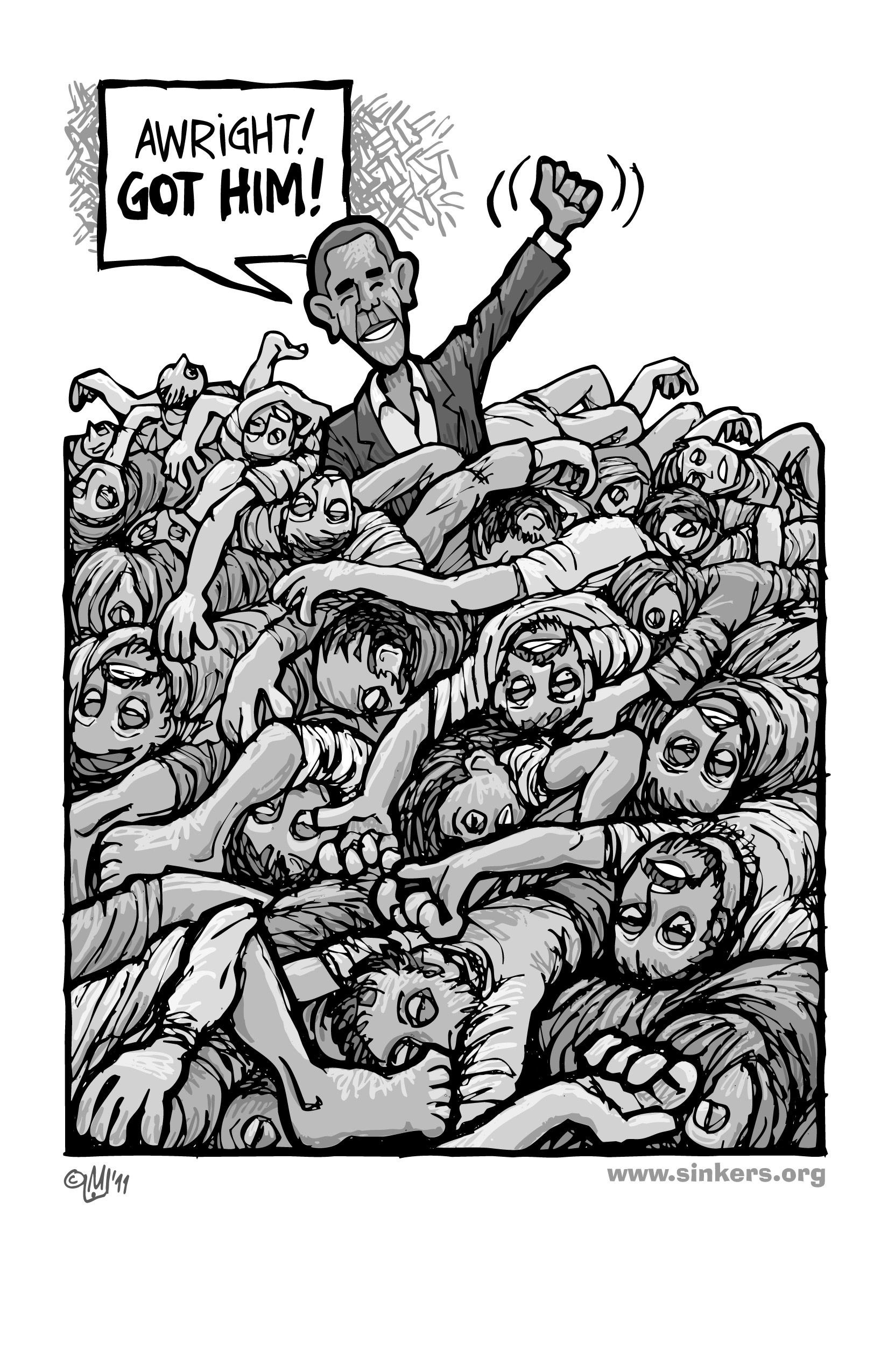
Monday, May 02, 2011
Wednesday, April 20, 2011
wound up
BOSTON -- It'll come as little surprise to anyone who has watched him head-butt the hoop upright before the start of a game, but Boston Celtics forward Kevin Garnett admits that he's often so wound up with intensity that he doesn't always remember exactly how things have played out over the course of the contest.
Asked about a key theft of Jared Jeffries in the final moments of Tuesday's Game 2 triumph over the New York Knicks, Garnett struggled to recall exactly what he was thinking or what he saw as the play developed.
"What's crazy is I don't remember anything about tonight," Garnett said.
Just thinking out loud here, but maybe head trauma is a better explanation for memory loss than "intensity."
Monday, March 28, 2011
is this meant to be funny?
The NYTimes says, about the debate leading up to bombing the shit out of Libya:
The Times assures us "Mrs. Clinton emphasized that the administration did not view the Libya intervention as a precedent." So I'm not the least bit worried that the Libya intervention will be used as a precedent!
"She and Mr. Gates will share the burden of selling the Libya policy at home and abroad." In other words, the leaders go to war regardless of what the people think, and then go around trying to convince a reluctant populace that war is a great idea. That sounds like how Democracy ought to work! Go Democrats!
[Clinton and Gates] and other senior officials had to weigh humanitarian values against national interests.and,
Defense Secretary Robert M. Gates acknowledged Sunday that the unrest in Libya did not pose an immediate threat to the United States.... On the key question of whether Libya constituted the kind of vital national interest that would normally justify military intervention, Mr. Gates offered a blunt denial .... “No, I don’t think it’s a vital interest for the United States"
So they had to choose between humanitarian values and a war that wasn't a vital interest. At least not the kind of interest that "normally" would "justify" killing lots of people. The Times seems to think that war is some plucky underdog facing long odds. But, somehow, the cute little underdog always overcomes the big bully of humanitarian values. America loves an underdog!
Hillary explained that Qaddafi has a "history" and might have caused problems, and besides, all our friends in the area (i.e. repressive Arab dictators) wanted us to bomb the shit out of Libya, so we had to help our friends, right? "Let's be fair, here." Bombs away!
The article explains what a great relationship Clinton and Gates have, "practically completing each others' sentences." We're told how Clinton fired Philip Crowley because Crowley said that the military was "mistreating" Bradley Manning by torturing him for months, which apparently Gates, a straight-talker who likes to "call a spade a spade," couldn't handle. On the other hand, "unified message [is] prized by the Obama White House," so maybe BO had a little something to do with it.
The Times assures us "Mrs. Clinton emphasized that the administration did not view the Libya intervention as a precedent." So I'm not the least bit worried that the Libya intervention will be used as a precedent!
"She and Mr. Gates will share the burden of selling the Libya policy at home and abroad." In other words, the leaders go to war regardless of what the people think, and then go around trying to convince a reluctant populace that war is a great idea. That sounds like how Democracy ought to work! Go Democrats!
Tuesday, March 22, 2011
Tuesday, March 15, 2011
Tuesday, March 08, 2011
it ain't my system!
Justin laments that "our system" produces people with idiotic ideas. Naturally that's what the system will produce, because the system isn't "ours." It's Theirs. And one thing They do is employ people to spout ideas that are idiotic, in the sense that the ideas fail to accurately describe reality and/or are internally inconsistent, but useful, in the sense that the ideas help to preserve and expand Their power.
Tuesday, February 22, 2011
rich people get screwed over by even richer people
When I read a story about a recent basketball trade, it made me realize that, whatever you think about highly paid professional entertainers generally, one has to acknowledge that a very difficult aspect of most of their lives is that they constantly have to move around. People want to be entertained by new things; the same two teams playing every night isn't considered fresh enough (despite the fact that we love a long playoff series...) Having to move around all the time could be fun for a few years when you're young, but when you reach a certain age it is nice to settle down. At least I think so.
Anyway, this trade is getting a lot of attention because it involves a "superstar" player being traded to New York City. I use the scare quotes because this player is a superstar not because he helps his team win, but because he makes a lot of flashy plays, or so say the data. So he's either stupidly more style than substance and happens to get rewarded for it, or he is cynically selfish and willingly makes his team worse in a way he can profit from. Perhaps the other facts suggest which. This player has (openly) been wanting to be traded to the NYC team for almost a year, while also refusing to turn down an (open) lucrative contract offer from his current team, and his pressure tactics finally seem to have worked. To accomodate his demands, the teams involved had to trade other players, who were (openly) considered mere pawns used to make the math work for the superstar player.
Well one of those "pawns" is the best player in the deal at helping teams win games (which is the ostensible professional responsibility of a basketball player), and one of the most respected veterans in the league. And he had openly been very happy to be living in Denver, where he grew up. And now, because of this trade forced by the young hotshot, he has to uproot his life and move from Denver to NYC. I know he's receiving rich financial reward for his services, but when I read:
"I can't deny that when the trade went down last night, I was kind of more sad than happy," Nuggets coach George Karl said after his team's short-handed shootaround Tuesday. "I think most of that sadness was because of Chauncey."it just hits home that these guys, despite being modern day gladiators, are also just people trying to make a living, and sometimes they get screwed over by some young hotshot and a systemic bias of the medium by which richer people make money off of them.
And then I realize that I can just pick a random story on the front page of the NYT and it will involve people getting screwed over way harder by people who are way richer, and without their own $15 million contract to ease their pain.
Monday, February 21, 2011
BINGO!
usually i just delete emails from my alma mater, but i paid attention to a recent one long enough to decide it deserves ridicule. check this out! let's have a big gambling contest and pretend we're learning something!
Monday, February 14, 2011
non-issues
Until your discipline can dispense with unproven modularity, gender and race essentialism, arguments from a presumed "mental fossil record" which of course can never be demonstrated, sociobiology, Dawkins' selfish gene and its general use as a justifier of the worst social norms and localized prejudices, I'm not really interested in discussing its value to leftist revolution.
- Jack Crow*
My discipline has never relied on unproven modularity. We have no interest in race essentialism, and to the extent that our theories involve what you might call "gender essentialism," they are supported by overwhelming cross-cultural evidence**. We don't argue from an undemonstrable mental fossil record, and we don't use The Selfish Gene to justify norms or prejudices, because we understand very well that one cannot infer a moral "ought" from an empirical "is."
So, now we can talk about the value of ev psych to leftist revolution!
* I don't mean to pick on Jack specifically. I like his writing, and I appreciate his willingness to discuss the topic. I think his views are likely shared by many others, so I'm using his public remarks as a representative sample of leftist objection to evolutionary psychology.
** Yes, we do think that just as there are, on average, physical differences between men and women, there are psychological differences, and that evolution explains these differences. This is a value-neutral observation, and we acknowledge huge variance in behaviours and preferences within and between sexes. These differences are in no way used by the discipline to encourage discrimination or to restrict individual freedom.
Sunday, February 13, 2011
advocacy is hard!
ok, i suppose i'm not really surprised to encounter such seething hostility to ev psych (see the comments sections). hell, if ev psych really were what they think it is, i'd be contemptuous too.
but i am surprised that these people, good folks with whom i so often agree in other domains, seem so confident in their criticism and rejection despite very strongly appearing to misunderstand fundamental principles. i understand that people have to choose what they want to spend their time learning about and that they have good reason not to have devoted as much time to the subject as me, but it appears to me that they're knocking down straw men and seem unwilling to even entertain the possibility that they're doing so. that's frustrating! i have thoughts about the mechanisms that poison people so strongly against ev psych, but i'll save that. i'm mostly just saying this for my own sanity (a good summary for the entire history of the blog), and don't intend to dwell on the point. and i don't mean any disrespect to anyone; i hope that's clear.
anyway, i think i'm going to try a different approach. every once in a while i'll highlight some good research. it is a lot easier to talk about one specific study than to just dive into a defense of an entire discipline against people who don't want to hear it. hopefully some of them will stick around for those more focused discussions.
questions for critics of evolutionary psychology
i've encountered lots of generalizations about the entire field, presumably based on exposure to a small sampling. and people seem to have some extremely confused ideas about ev psych. so i'm wondering exactly where you're getting your info. mainstream media? primary literature? books?
Chomsky on Egypt
We should remember there's an analog here. I mean, it's not the same, of course, but the population in the United States is angry, frustrated, full of fear and irrational hatreds. And the folks not far from you on Wall Street are just doing fine. They're the ones who created the current crisis. They're the ones who were called upon to deal with it. They're coming out stronger and richer than ever. But everything's fine, as long as the population is passive. If one-tenth of one percent of the population is gaining a preponderant amount of the wealth that's produced, while for the rest there 30 years of stagnation, just fine, as long as everyone's quiet. That's the scenario that has been unfolding in the Middle East, as well, just as it did in Central America and other domains.
...
Furthermore, Egypt cooperates in the crushing of Gaza. That terrible free election in January 2006 not only frightened the U.S. and Israel -- they didn't like the outcome, so turned instantly to punishing the Palestinians -- but the same in Egypt. The victor in the election was Hamas, which is an offshoot of the Muslim Brotherhood. That was very much feared by the Egyptian dictatorship, because if they ever allowed anything like a free election, the Muslim Brotherhood would no doubt make out quite well, maybe not a majority, but it would be a substantial political force. And they don't want that, so therefore they cooperate. Egypt, under Mubarak, cooperates with Israel in crushing [Gaza], built a huge fence on the Egyptian border, with U.S. engineering help, and it sort of monitors the flow of goods in and out of Gaza on the Egyptian side. It essentially completes the siege that the U.S. and Israel have imposed. Well, all of that could erode if there was a democratic movement that gained influence in Egypt, just as it did in Palestine.
source.
Saturday, February 12, 2011
evolutionary psychology for leftist anarchist types
I'm always surprised by the hostility to evolutionary psychology (ev psych) from the left (meaning further left than loyal Democrats), because I consider the science extremely supportive of the leftist-anarchist worldview. Since many bloggers cover political issues much better than me, maybe as a lefty-anarchist evolutionary psychologist, my blogging efforts would be well spent debunking some common objections to ev psych and highlighting some findings that should be of great interest to. My first pass will skip the references (I'm feverishly ill, but fired up), but if people comment and want the primary literature I'll be happy to provide it!
First of all, the theory of evolution by natural selection is the unifying principle of biology. Since humans are biological organisms, we are no more exempt from the forces of evolution than any other life form. I actually am kind of uncomfortable calling myself an "evolutionary psychologist" because psychology, being the science of brain and behaviour, must be evolutionary; if a central principle or finding in psychology conflicts with evolutionary theory, something is wrong! Furthermore, evolutionary theory has been wildly successful at predicting and explaining animal behaviour, including human behaviour.
Misconceptions (feel free to suggest other objections for me to try to debunk!):
In a comment thread over at Jack's place, I encountered a few common misconceptions about ev psych, all of which I'd like to eventually address, respectfully. Among them (these aren't necessarily exact quotes, just my understanding of the objections raised):
1. "Sexual attraction is not scientific."
I think the intended meaning (correct me if I'm wrong) is that sexual attraction isn't a topic that science can attempt to understand. If that's the intended meaning, it is very wrong. We know a great deal about the science of sexual attraction; see my comments in that thread for an intro, and feel free to post questions in the comments.
2. "Ev psych is Lamarkism applied to mind."
Originally I wrote: Nobody (or close to it) takes Larmkian inheritance of acquired characteristic seriously in any field of biology, ev psych included. If you think otherwise, please provide specific references and I'll gladly take a look.
Update: I was a bit hasty with the outright dismissal of inheritance of acquired characteristics, because a lot of work in epigenetics is showing exactly that. Still, I don't know of much, if any, use of Lamarck's theories in ev psych; our models are Darwinian (and modern synthesis).
3. "Ev psych claims that human nature is fixed, which can't possibly be right given the extraordinary variety in human behaviour, culture, and social structure."
Indeed, it cannot possibly be right that human nature is fixed. Learning, conditioning, and plasticity are very important parts of understanding behaviour. I think this misunderstanding comes from a root confusion thinking that "genetically based" means fixed. A better way to think of it is that our genetic structure allows flexibility within a certain range.
One commenter highlighted the common occurrence of cross-species adoption, presumably as a way to argue "evolution could not possibly favor an animal investing so heavily in the offspring of another species?" The confusion here is between proximate and ultimate levels of explanation. Evolution by natural selection creates proximate mechanisms that are adaptive on average. That "on average" is key! In the case of cross-species adoption, the evolved proximate mechanism might be something like "take care of younglings in my nest." Since the vast majority of such younglings would be your own offspring, this behavioural tendency is adaptive on average. But there are many species, cuckoos for example, that exploit parental sollicitude mechanisms as a way to avoid the cost of raising their own offspring.
4. "Ev psych is innately conservative."
The next section mentions some key findings that I think are deeply subversive, but I'd be curious to hear what people think are the conservative aspects of ev psych.
Findings that lefties ought to like:
1. Inequality seems to be at the root of a variety of social ills.
Since natural selection can be conceived of as intrasexual competition for a share of the parentage of the next generation, it follows that inequality of outcome should be associated with heightened competition. Where there is a "winner take all" situation, for example in elephant seals, where one dominant male beachmaster gains the vast majority of sexual access to females and thus a large share of the parentage, we expect fierce competition, which we certainly see. Humans are no different! There is no better predictors of male-male homicide (from a cross-national scale, all the way down to neighborhood level) than income inequality (except possibly life expectancy, which I can address later if someone is curious). A variety of other social ills (e.g. a myriad of health outcomes, problem gambling, traffic fatalities) are also strongly correlated with income inequality. Correlation doesn't equal causation, but the findings are overwhelmingly supportive of the basic concepts of biology, and are equally supportive of the anarchist worldview of skepticism towards power structures! A common confusion is that these issues are related to absolute poverty, as opposed to relative poverty, but these correlations remain extremely strong once you control for various poverty measures (plus poverty is a relative concept anyway).
2. The classical economics model of humans as purely self-interested rational maximizers is totally inadequate.
Cooperation and conflict is my specialty within the field, and there are dozens, if not hundreds, of studies debunking the conservative models common in economics. In fact one group of evolution-minded researchers has proposed that humans are innately cooperative, even in situations where we do not stand to gain ("strong reciprocity" theory); I find the details slightly misguided, but its popularity if nothing else is indicative of how seriously the discipline takes cooperation and altruism as a fundamental characteristic of human psychology.
Ok, that's all for now. I'll update or make new posts if I attract some attention.
Subscribe to:
Posts (Atom)